









Nvidia? The gaming GPU company?
On Monday, the multi-trillion dollar AI chipmaker unveiled its latest effort at weaving advances in AI into video games, and it immediately backfired.
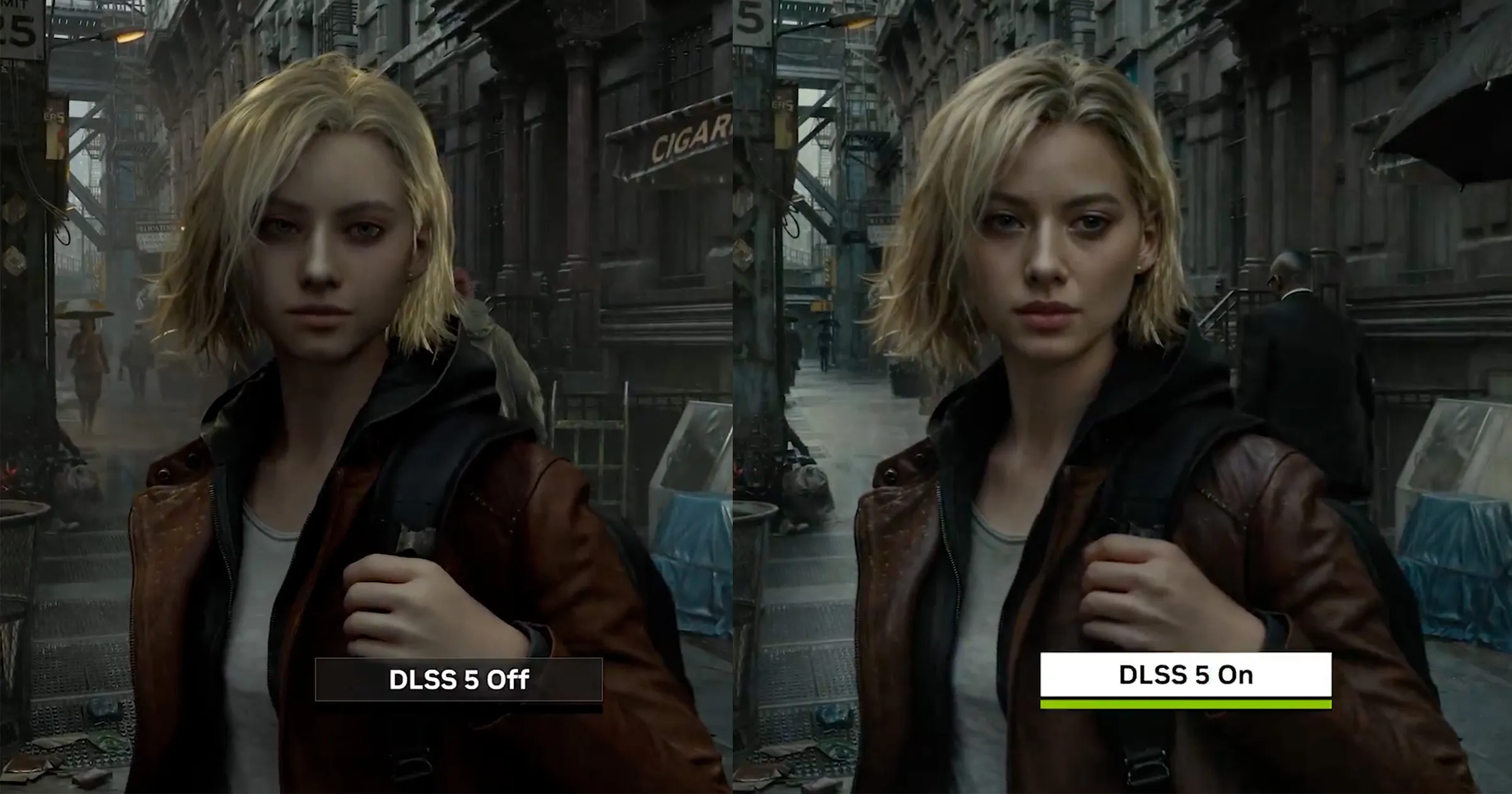
The feature, DLSS 5, is supposed to be a souped-up version of the deep-learning upscaling tech Nvidia has offered since 2018. The company called it its “most significant breakthrough in computer graphics since the debut of real-time ray tracing” in that same year. But the reactions to demo footage shared has been overwhelmingly negative.
Gamers and developers fumed against the announcement, calling it “slop” and a “betrayal” of games’ artistic intent. Memes spread parodying the AI feature’s garish aesthetic, in which an original character or person is contrasted with a “DLSS 5” image that shows the subject in an unrecognizable style. Some even gave it a harsh nickname: “sloptracing,” a play on Nvidia’s ray tracing tech.
The reactions are warranted. Rather than just providing a little clarity to a fuzzy image, the feature looks more like a glorified Snapchat filter, varnishing the art style of your favorite games with an overwrought, generative AI finish.
The effect is most noticeable when applied to faces. Iconic characters in the demo like Leon Kennedy from the Resident Evil franchise are, it’s no exaggeration to say, literally yassified.
According to Nvidia’s announcement, DLSS 5 “introduces a real-time neural rendering model that infuses pixels with photoreal lighting and materials.” It takes a “game’s color and motion vectors for each frame as input, and uses an AI model to infuse the scene with photoreal lighting and materials that are anchored to source 3D content.”
This AI model, it says, “is trained end to end to understand complex scene semantics such as characters, hair, fabric and translucent skin.”
Nvidia chief Jensen Huang was effusive about the tech’s implications, calling it gaming’s “GPT moment.”
“DLSS 5 is the GPT moment for graphics — blending hand-crafted rendering with generative AI to deliver a dramatic leap in visual realism while preserving the control artists need for creative expression,” he said in the announcement.
It’s a little hard to buy Huang’s promise of preserving creative expression, however, when in all of the examples shared, DLSS 5 dramatically alters the aesthetic of the games. More than that, it exemplifies how generative AI uniformly reinforces bland aesthetic norms and defaults to gooner beauty standards. (Grace Ashcroft from the upcoming Resident Evil game gets hollower cheeks, stronger cheekbones, and poutier lips.) The games no longer look like games, but like any other clip spat out by a video generating model that gets shared in AI circles with a caption like “Hollywood is cooked.”
Nvidia says DLSS 5 is arriving this fall — but, it seems, only to participating games that will include Resident Evil Requiem, Starfield, Hogwarts Legacy, and Assassin’s Creed Shadows. These are major titles, though, a show of how Nvidia says its feature is being supported by the industry’s biggest publishers and developers, like Capcom, Bethesda, Ubisoft, and Warner Bros Games.
More on AI: Unity Says It Has a New Product That Cooks Up Entire Games Using AI