








Introduction
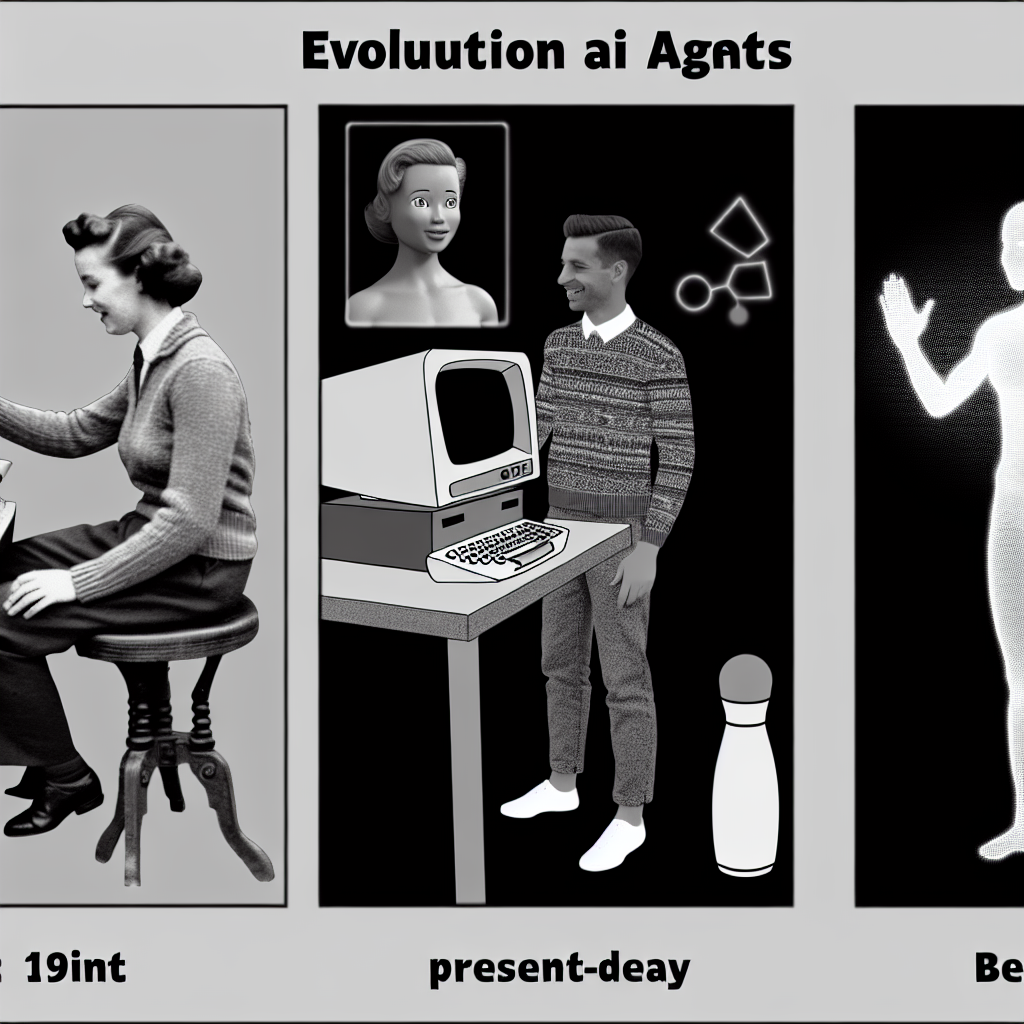
Artificial Intelligence (AI) agents are systems designed to perform specific tasks autonomously or assist human users in completing complex goals. As technology continues to evolve, the demand for intelligent agents capable of adapting, learning, and collaborating in various environments has grown significantly. The challenge lies in developing agents that can effectively operate in dynamic and often unpredictable settings, making the design of AI agents a multifaceted problem.
This article aims to delve into the intricacies of AI agents, providing a structured approach to understanding their workings, implementation strategies, and practical applications. We will explore different models, algorithms, and frameworks used in the development of AI agents, offering insights through code examples and case studies.
Understanding AI Agents
What is an AI Agent?
An AI agent can be defined as an entity that perceives its environment through sensors and acts upon that environment through actuators. These agents can be categorized based on their complexity and functionality:
- Simple Reflex Agents: Operate based on predefined rules (if-then statements).
- Model-Based Agents: Maintain an internal state to make decisions based on their environment’s history.
- Goal-Based Agents: Have specific objectives and can plan actions to achieve these goals.
- Utility-Based Agents: Assess the desirability of different states and choose actions that maximize their expected utility.
Key Challenges in AI Agent Development
- Perception: How to accurately gather and interpret data from the environment.
- Decision Making: Developing algorithms that can effectively evaluate options and make optimal decisions.
- Learning: Enabling agents to improve their performance over time through experience.
- Collaboration: Designing agents that can work together or interact with humans effectively.
Step-by-Step Technical Explanation
Basic Concepts of AI Agents
1. Perception and Environment
An AI agent perceives its environment using sensors. The environment can be represented as a state space, where each state corresponds to a specific configuration of the environment.
- Sensors: Devices or algorithms to gather data (e.g., cameras, microphones, APIs).
- Actuators: Mechanisms through which agents act (e.g., motors, software commands).
python
class SimpleAgent:
def init(self):
self.state = None
def perceive(self, environment):

    self.state = environment.get_state()
def act(self, action):

    environment.perform_action(action)
2. Decision-Making Frameworks
Agents need decision-making frameworks to determine the best course of action. Common approaches include:
- Rule-Based Systems: Use conditional rules to guide decision-making.
- Search Algorithms: Explore possible actions to find optimal solutions (e.g., A* search).
- Reinforcement Learning: Learn from interaction with the environment to maximize cumulative rewards.
Advanced Techniques
1. Reinforcement Learning
Reinforcement Learning (RL) is a powerful technique where agents learn to make decisions by receiving rewards or penalties.
Key Components:
- Agent: Learns to perform actions.
- Environment: The context in which the agent operates.
- Actions: Choices made by the agent.
- Reward: Feedback from the environment.
python
import numpy as np
import random
class ReinforcementAgent:
def init(self, actions):
self.q_table = np.zeros((state_space_size, len(actions)))
self.actions = actions
def choose_action(self, state, epsilon):

    if random.random() < epsilon:

        return random.choice(self.actions)  # Exploration

    else:

        return np.argmax(self.q_table[state])  # Exploitation
def update_q_value(self, state, action, reward, next_state, alpha, gamma):

    best_next_action = np.argmax(self.q_table[next_state])

    td_target = reward + gamma * self.q_table[next_state][best_next_action]

    self.q_table[state][action] += alpha * (td_target - self.q_table[state][action])
Practical Solutions and Code Examples
1. Building a Simple AI Agent
Let’s create a simple AI agent that navigates a grid environment using Q-learning, a popular RL algorithm.
python
import numpy as np
class GridEnvironment:
def init(self, grid_size):
self.grid_size = grid_size
self.state = (0, 0) # Start at the top-left corner
self.goal = (grid_size – 1, grid_size – 1) # Goal at bottom-right corner
def get_state(self):

    return self.state
def perform_action(self, action):

    # Define possible actions: 0=up, 1=right, 2=down, 3=left

    if action == 0 and self.state[0] > 0:  # Up

        self.state = (self.state[0] - 1, self.state[1])

    elif action == 1 and self.state[1] < self.grid_size - 1:  # Right

        self.state = (self.state[0], self.state[1] + 1)

    elif action == 2 and self.state[0] < self.grid_size - 1:  # Down

        self.state = (self.state[0] + 1, self.state[1])

    elif action == 3 and self.state[1] > 0:  # Left

        self.state = (self.state[0], self.state[1] - 1)
return self.state == self.goal  # Return True if goal is reached
def train_agent(episodes=1000, grid_size=5):
env = GridEnvironment(grid_size)
agent = ReinforcementAgent(actions=[0, 1, 2, 3])
for episode in range(episodes):

    state = env.get_state()

    done = False

    while not done:

        action = agent.choose_action(state, epsilon=0.1)

        done = env.perform_action(action)

        next_state = env.get_state()

        reward = 1 if done else 0

        agent.update_q_value(state, action, reward, next_state, alpha=0.1, gamma=0.9)

        state = next_state
train_agent()
2. Comparison of Algorithms
To effectively compare different approaches to building AI agents, we can summarize their characteristics in a table.
| Algorithm | Complexity | Learning Type | Example Use Cases |
|---|---|---|---|
| Q-Learning | Medium | Model-free RL | Grid navigation, game playing |
| Deep Q-Networks | High | Model-free RL | Complex games, robotics |
| Rule-Based Systems | Low | Predefined rules | Simple decision-making tasks |
| Genetic Algorithms | Medium | Evolutionary | Optimization problems |
Visualizing AI Agent Architecture
mermaid
flowchart TD;
A[Agent] –>|Perceives| B[Environment];
B –>|Returns State| A;
A –>|Acts| C[Actions];
C –>|Affects| B;
Case Studies
Case Study 1: Autonomous Vehicle Navigation
An AI agent equipped with sensors (LIDAR, cameras) can navigate through urban environments. By using deep reinforcement learning, these agents learn to make decisions based on real-time data, optimizing paths while avoiding obstacles. The challenge lies in ensuring the agent can generalize its learning across different scenarios.
Case Study 2: Customer Service Chatbots
Chatbots act as AI agents that assist customers by answering queries. They utilize natural language processing (NLP) and machine learning techniques to understand user intent and provide relevant responses. The implementation of a feedback loop allows these agents to learn from interactions, refining their responses over time.
Conclusion
AI agents represent a significant advancement in the field of artificial intelligence, providing solutions that can operate autonomously or assist users in various applications. By understanding the fundamental concepts of perception, decision-making, and learning, developers can create agents that are not only effective but also adaptable.
Key Takeaways
- Understanding the environment and using appropriate sensors is crucial for effective agent design.
- Decision-making frameworks, particularly reinforcement learning, empower agents to learn from their experiences.
- Continuous learning and adaptation are vital for agents operating in dynamic environments.
Best Practices
- Start with simple models and gradually incorporate complexity.
- Use simulation environments for training agents before deploying them in real-world scenarios.
- Continuously monitor and update agent performance to ensure optimal operation.
Useful Resources
-
Libraries:
- OpenAI Gym: A toolkit for developing and comparing reinforcement learning algorithms.
- TensorFlow: An open-source library for machine learning.
- Keras: A high-level neural networks API.
-
Frameworks:
- Ray: A unified framework for building and running distributed applications.
- Rasa: An open-source framework for building conversational AI.
-
Research Papers:
- “Playing Atari with Deep Reinforcement Learning” by Mnih et al.
- “Human-level control through deep reinforcement learning” by Mnih et al.
By understanding and implementing these concepts, you can create sophisticated AI agents capable of tackling a wide array of challenges in various domains.